







Is cleaning panels really worth it? Real cost-benefit analysis
When it comes to cleaning photovoltaic panels, it’s easy to come across claims promising performance increases of 30%, 35% or even higher. But how much of these numbers is actually real?
In most cases these are generic figures, often taken out of context, that don’t consider the real operating conditions of a system. And that’s exactly where the most common doubt arises.
Is cleaning photovoltaic panels really worth it, or is it an avoidable expense?
If we look at the issue in a practical way, the real question one should ask is:
Does the value of the recovered energy justify the cost of cleaning?
To answer credibly, theory isn’t enough. A real comparison is needed, based on data measured under controlled conditions.
That’s why we carried out a 12-month field analysis, in which two identical photovoltaic systems for solar energy production were monitored, installed under the same environmental conditions but managed through two separate inverters. This made it possible to directly compare energy output, isolating external variables as much as possible. Through continuous recording of the energy produced by each inverter, it was possible to precisely determine the performance gap between cleaned panels and panels not subject to maintenance.
The goal is to understand whether cleaning is a sensible expense or not, and above all in which situations it is truly worthwhile.
The baseline data
The system analyzed consists of two 9.6 kW photovoltaic sections each. The two strings are installed with identical exposure and tilt. During the monitoring period:
· one string underwent scheduled cleaning.
· the other was left with no interventions.
On an annual basis, each section has historically recorded an average production of 10,220 kWh under normal operating conditions.
The value of the energy was calculated considering average self-consumption, with an avoided cost of €0.23/kWh.
As for maintenance, the cost of a professional cleaning intervention for a system of this size was €180 per intervention.
These data form the basis for a concrete assessment of the relationship between recovered energy and cleaning cost.
How the test was managed
During the 12 months of monitoring, the “clean” string underwent two washings per year, while the second string remained without any maintenance.
Cleanings were carried out at specific times:
• early April
• late September
This choice is not random, but comes from direct observation of the system’s behavior.
In the spring months, after winter, the panels show a significant buildup of dirt. At the same time, solar irradiance is not yet at its peak intensity: having a clean surface therefore makes it possible to make the most of even less intense radiation.
A similar dynamic returns in autumn, when dust and residues accumulated during summer begin to reduce efficiency. Acting at this time helps maintain good performance even in months with less available light.
During the summer period, instead, the high irradiance intensity tends to partly offset the presence of surface dirt, making the immediate benefit of cleaning less evident.
Two interventions per year therefore represent the best balance between cleaning cost and recovered energy.
Annual results
Analyzing the data collected on the two inverters over 12 months, the comparison between the two strings shows a significant difference.
The section subject to scheduled cleaning produced 11,784 kWh, while the unmaintained string stopped at 10,012 kWh.
The real difference is 1,772 kWh more energy in one year
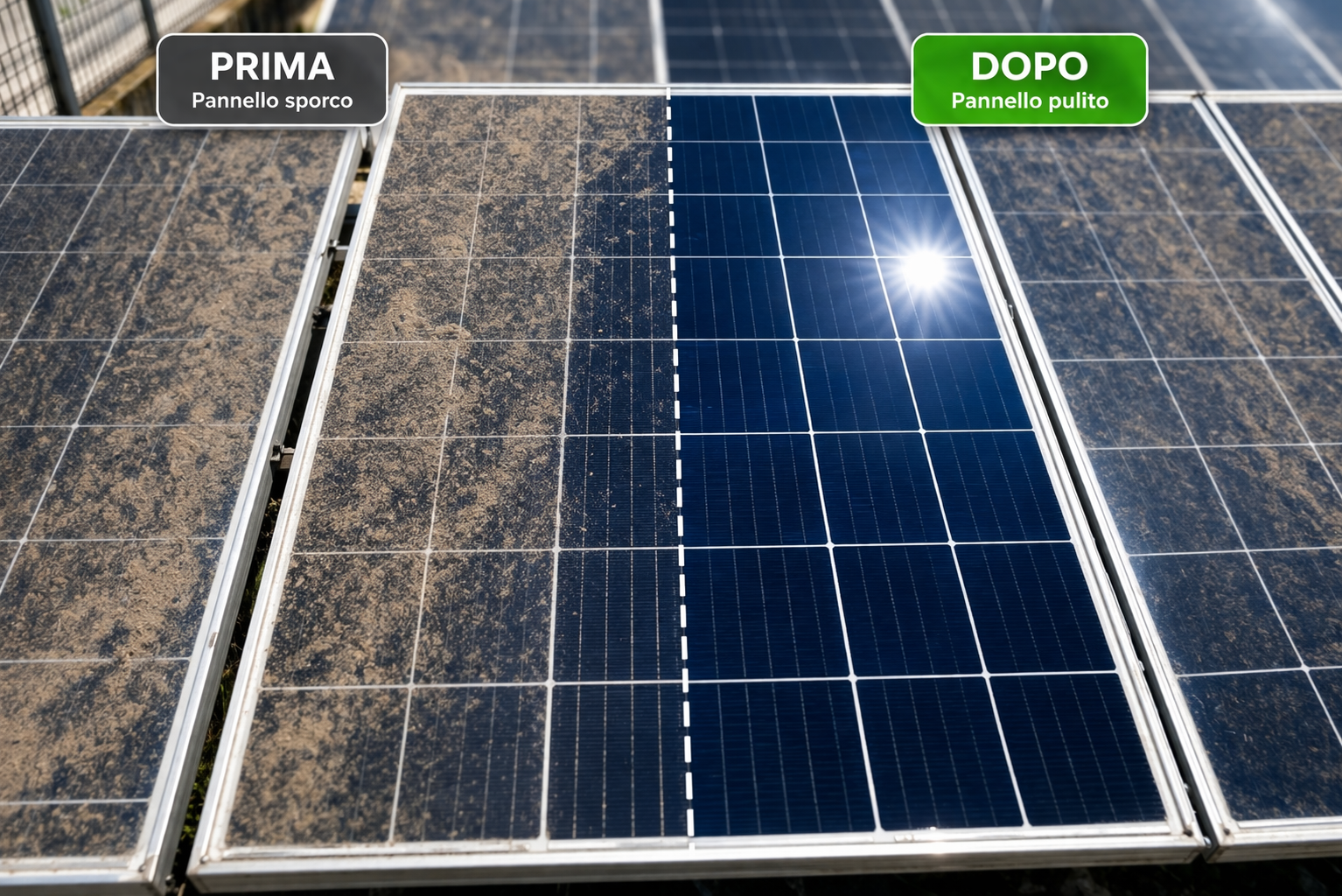
This is an increase of +17.7%, due to the progressive buildup of dirt on the uncleaned string.
A figure that falls within the real values of performance loss of dirty photovoltaic panels, often underestimated during maintenance.
Economic translation
Assigning energy an average value of €0.23/kWh, the annual economic recovery is €407.56
This represents the real cost of energy lost due to dirt on the solar panels.
Comparison with the cost of cleaning
Over the year, 2 washing interventions were carried out at a cost of €180, for a total cost of €360
The economic conclusion
At this point the figure is straightforward:
€407.56 recovered – €360 cost = +€47.56
Cleaning, even in this real scenario, generates a positive balance.
The real advantage (often underestimated)
The result obtained represents an average condition, without considering variables that in practice tend to further improve the balance:
• larger or more efficient systems
• dustier or urban settings
• longer periods without rain
• higher energy cost
Under these conditions, the production differential increases, while the cleaning cost remains unchanged.
In conclusion, we can state that cleaning photovoltaic panels with professional interventions is economically worthwhile if done at the right frequency, and failure to clean leads to a real and continuous loss of energy.
But what if I told you that you can save hundreds of euros every year?
At this point the reasoning becomes even more interesting, but is it possible to further increase the annual economic gain?
The answer is yes.
If the annual recovery is €407.56, the decisive factor becomes the cost of cleaning.
If we assume we manage maintenance ourselves, and are consistent with annual interventions, the energy recovery turns almost entirely into net profit.
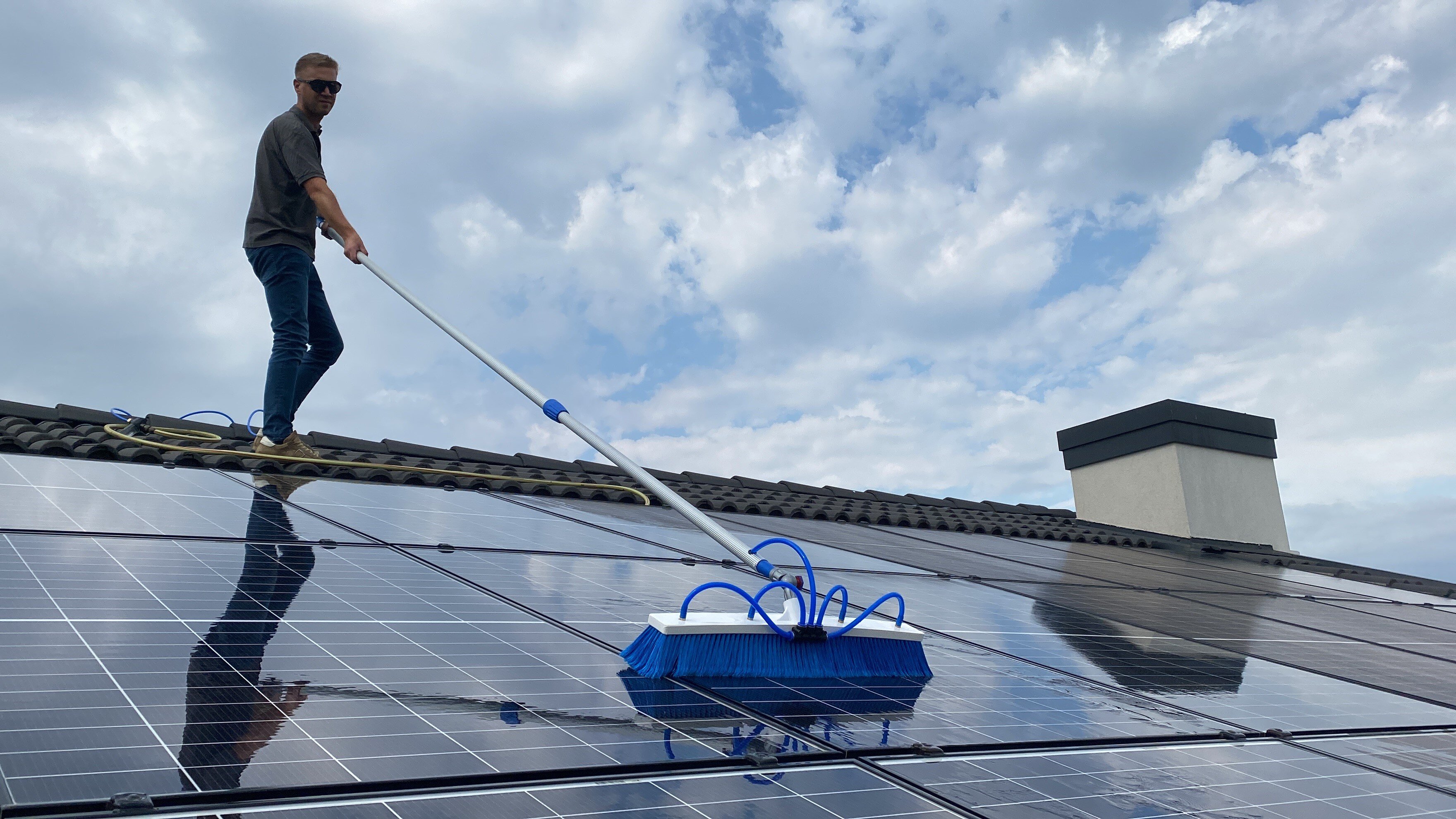
A photovoltaic cleaning kit like BrillSolar, costing €149, is a one-time investment.
An investment that pays for itself in less than 6 months
How much you earn over time
Already in the first year:
• energy recovered: €407.56
• equipment cost: €149
• net profit: €258.56
Over a 5-year horizon:
• energy recovered: €2,037.80
• equipment cost: €149
• net gain: €1,888.80
The real difference
What clearly emerges is that cleaning photovoltaic panels is not just a maintenance practice, but a real economic lever.
With a professional service, the system is already at break-even.
With independent and consistent management, it becomes a systematically advantageous operation.
The difference is not “whether to clean”, but “how to do it”
Final consideration
In a system designed to produce energy for 20–25 years, neglecting cleaning means accepting a constant and cumulative loss.
On the contrary, with a modest investment and regular maintenance, an invisible loss is turned into a concrete and ongoing gain over time.
FAQ – Photovoltaic panel cleaning
How often should photovoltaic panels be cleaned?
Generally, 2 times a year (spring and autumn) is the optimal frequency.
How much output is lost with dirty panels?
In real conditions, the loss can reach up to 15–20% per year.
Is it worth cleaning the panels yourself?
Yes, if you use specific tools that ensure effectiveness and safety.
What tools should be used to clean solar panels?
Brushes with technical bristles and continuous water-flow systems designed not to scratch the glass.
Do you need a specific detergent?
Yes, especially for stubborn dirt, to avoid residue and improve the result.